
Indian Staffing Agency: A Complete Guide to Workforce Solutions for Businesses
An Indian staffing agency helps businesses find suitable employees for their workforce requirements by connecting employers with candidates who have the relevant skills, qualifications, and experience. From skilled and semi-skilled workers to operational and industry-specific staff, staffing agencies support organizations in managing recruitment and meeting business demands.
As businesses expand, launch new projects, or manage changing workforce needs, finding the right employees at the right time becomes increasingly important. Working with a reliable staffing agency in India can help companies organize recruitment, identify suitable candidates, and streamline the hiring process.
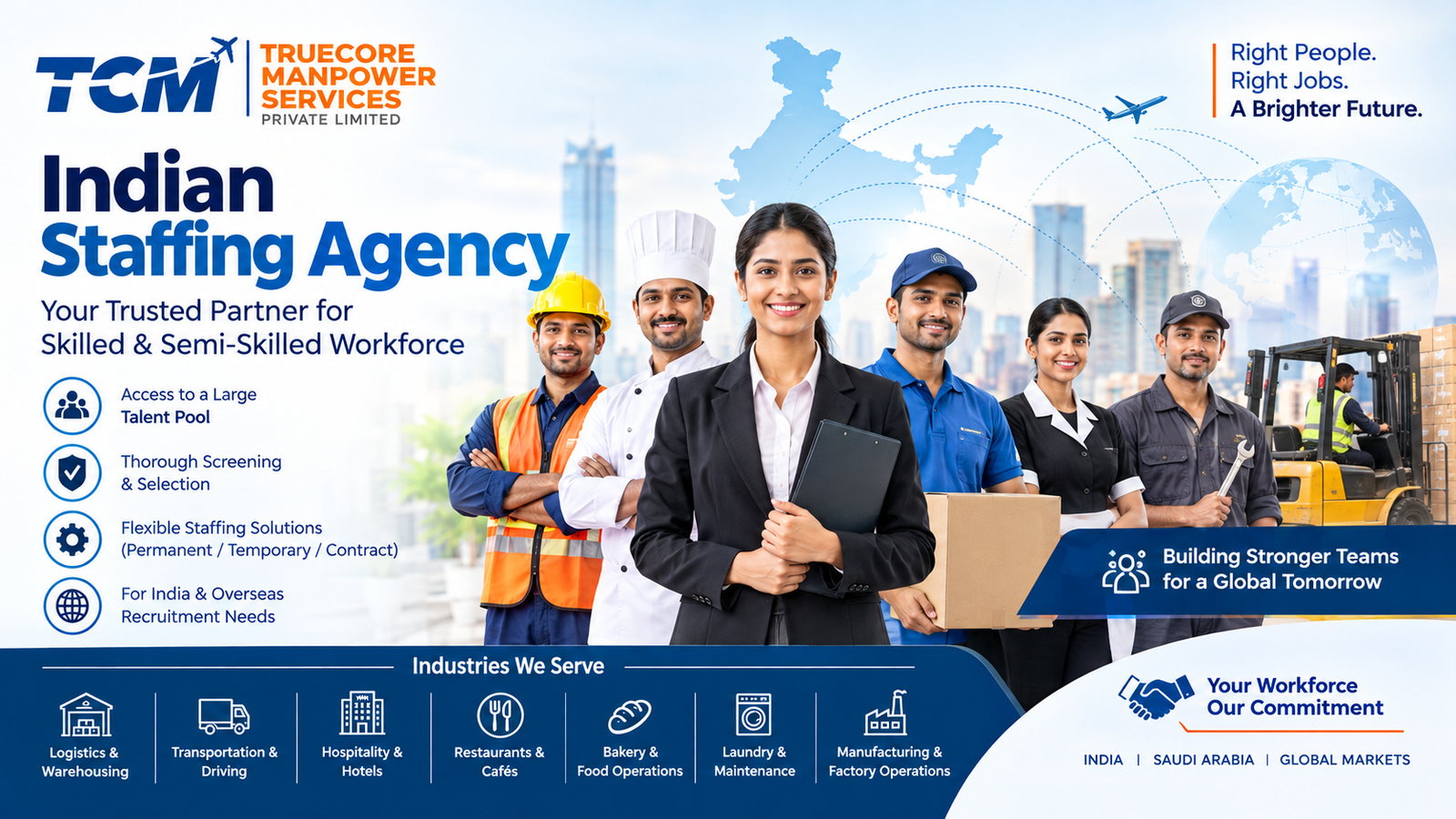
True Core Manpower Services Private Limited (TCM) supports workforce recruitment requirements across industries such as logistics, warehousing, transportation, hospitality, restaurants, bakery operations, laundry, maintenance, and manufacturing. The company assists employers seeking Indian talent for domestic and international workforce requirements, subject to the applicable recruitment arrangements.
This guide explains what an Indian staffing agency does, the services it may provide, the industries it supports, and how businesses can select the right recruitment partner.
What Is an Indian Staffing Agency?
An Indian staffing agency is a recruitment service provider that helps employers identify and hire candidates for specific job roles. Depending on its business model and service scope, a staffing agency may support permanent recruitment, temporary staffing, contract staffing, bulk hiring, and specialized workforce sourcing.
Staffing agencies work with businesses across different sectors to understand their employee requirements and identify candidates who match the required job profiles.
Common staffing activities include:
-
Understanding employer workforce requirements.
-
Sourcing candidates through relevant recruitment channels.
-
Reviewing candidate qualifications and experience.
-
Screening and shortlisting applicants.
-
Coordinating interviews and assessments.
-
Supporting recruitment documentation.
-
Coordinating with employers and candidates during the selection process.
The exact services offered depend on the agency’s capabilities, the recruitment agreement, and applicable employment regulations.
Why Do Businesses Choose an Indian Staffing Agency?
Recruitment can require considerable time, coordination, and resources. Businesses often work with staffing agencies to organize hiring and reach candidates who match their operational needs.
1. Access to a Wider Candidate Pool
A staffing agency can use its recruitment networks and sourcing channels to identify candidates for different job categories. This may help employers reach applicants beyond their existing recruitment channels.
2. Industry-Specific Recruitment
Different industries require different skill sets. For example, warehouse operations may require material-handling experience, while hospitality businesses may prioritize customer service and operational skills. An agency that understands the relevant industry can align candidate sourcing with the employer's requirements.
3. Support for Bulk Hiring
Companies opening new facilities, expanding operations, or starting projects may need to recruit several employees within a defined period. A structured recruitment process can help coordinate multiple vacancies, candidate shortlists, interviews, and selection updates.
4. Reduced Recruitment Workload
Candidate sourcing and initial screening can consume significant internal resources. Outsourcing some recruitment activities may allow an employer's internal team to focus on final interviews, employee onboarding, and business operations.
5. Flexible Workforce Planning
Depending on the services offered, staffing agencies may help businesses recruit for permanent, temporary, or contract-based positions. Employers should clearly define the employment arrangement before recruitment begins.
Staffing Services Offered by an Indian Staffing Agency
Staffing requirements vary according to company size, industry, and workforce planning needs. Businesses should select recruitment services based on the positions they need to fill.
Permanent Staffing
Permanent staffing involves recruiting candidates for ongoing positions within an organization. The process typically includes defining the job profile, sourcing applicants, screening candidates, conducting interviews, and completing the employer’s hiring procedures.
Temporary Staffing
Temporary staffing supports businesses that need workers for a limited period. These requirements may arise from seasonal demand, short-term projects, temporary workload increases, or specific operational needs.
The employment arrangement and responsibilities should be clearly established in the staffing agreement.
Contract Staffing
Contract staffing involves hiring arrangements based on defined contractual terms. Depending on the structure, a staffing provider may assist with candidate sourcing and coordination, while employment, payroll, and statutory responsibilities must be allocated in accordance with the contract and applicable law.
Bulk Recruitment
Bulk recruitment is useful when an employer needs multiple workers for the same or different positions.
A planned bulk-hiring process may include:
-
Identifying the number of vacancies.
-
Defining the required qualifications and experience.
-
Sourcing candidates for each job category.
-
Coordinating interviews and assessments.
-
Tracking selection and documentation.
-
Supporting joining-related communication.
Skilled and Semi-Skilled Workforce Recruitment
Businesses across industrial, service, and operational sectors may require workers with specific practical skills or relevant experience.
An Indian staffing agency can help employers source candidates according to the technical, operational, and experience requirements of each position.
Industries Served by Indian Staffing Agencies
Staffing needs differ across sectors. Understanding the responsibilities and working conditions associated with each industry helps employers establish appropriate candidate-selection criteria.
True Core Manpower supports recruitment requirements across several workforce categories.
1. Logistics and Warehousing
Logistics and warehouse businesses require employees to support goods handling, inventory movement, storage, and distribution.
Potential positions include:
-
Warehouse workers
-
Loaders and material handlers
-
Warehouse supervisors
-
Logistics support staff
-
Inventory-related operational personnel
Candidate selection depends on the job responsibilities, practical experience, equipment knowledge, and employer requirements.
2. Transportation and Driving
Transportation companies may need drivers and other operational staff for different vehicle categories and delivery requirements.
Employers should specify the required driving experience, licence category, safety knowledge, and any additional authorizations needed for the position.
3. Hospitality and Hotels
Hotels and hospitality businesses recruit employees to support guest services and day-to-day operations.
Depending on the vacancy, staffing requirements may include front-of-house support, housekeeping, food service, kitchen operations, and other hospitality-related roles.
4. Restaurants, Cafés, and Bakery Operations
Restaurants, cafés, and bakeries depend on employees who can support food preparation, service, kitchen operations, and workplace hygiene.
Candidate requirements should reflect the duties, experience level, practical skills, and training needed for each role.
5. Laundry and Maintenance
Commercial laundries, hotels, facilities, and industrial businesses may require employees for routine services, equipment operations, and maintenance activities.
Recruitment criteria should specify the required practical abilities, equipment familiarity, technical knowledge, and experience.
6. Manufacturing and Factory Operations
Manufacturing businesses may require workers for production activities, factory operations, equipment-related tasks, and other industrial responsibilities.
The candidate profile depends on the production environment, required skills, workplace safety procedures, and technical experience.
Indian Staffing Agency for Overseas Recruitment
A structured recruitment process helps international employers move from identifying vacancies to selecting suitable candidates.
Step 1: Share Your Manpower Requirements
The employer provides details about the vacancies, job responsibilities, number of workers required, experience, qualifications, salary, employment conditions, and destination country.
Clear requirements help the recruitment agency understand the expected candidate profile.
Step 2: Candidate Sourcing in India
The recruitment agency searches relevant candidate networks and sourcing channels to identify applicants who match the specified positions.
The sourcing strategy depends on the job category, number of vacancies, experience requirements, and candidate availability.
Step 3: Screening and Shortlisting
Candidates are assessed against the employer’s requirements. Depending on the role, screening may include reviewing qualifications, employment history, practical skills, supporting documents, and availability.
Only candidates who meet the agreed screening criteria should proceed to the relevant selection stage.
Step 4: Interviews and Candidate Selection
The employer reviews shortlisted profiles and conducts interviews or assessments according to its recruitment process.
For technical and operational positions, employers may require practical assessments or additional skill verification.
Step 5: Documentation and Employment Formalities
After selection, the required documentation and employment procedures are coordinated according to the applicable requirements.
Overseas recruitment may involve employment contracts, passport and visa documentation, medical examinations, work authorization, and destination-country formalities, depending on the circumstances.
Step 6: Joining and Deployment Coordination
The final stage involves coordinating the next steps with the employer and selected candidates.
Joining arrangements, travel coordination, and deployment activities depend on the agreed service scope and applicable approvals.
Indian Staffing Agency for Overseas Recruitment
Indian staffing and recruitment providers may also support employers seeking candidates for overseas employment, depending on their applicable authorizations and service scope.
International employers often need workers for operational, technical, industrial, and service-related positions. India can be a candidate-sourcing market for businesses seeking workers whose experience and qualifications match their vacancies.
Recruitment for Saudi Arabia and Gulf Countries
Employers in Saudi Arabia and other Gulf countries may recruit Indian candidates for logistics, warehousing, transportation, hospitality, restaurant operations, maintenance, and manufacturing.
A structured recruitment process helps employers communicate their requirements and evaluate candidates against defined criteria.
The recruitment process may involve:
-
Sharing job descriptions and vacancy details.
-
Defining salary, experience, and qualification requirements.
-
Sourcing and screening suitable candidates.
-
Coordinating interviews and selection.
-
Completing required documentation and employment formalities.
-
Coordinating joining or deployment arrangements as agreed.
International hiring must follow applicable Indian overseas recruitment rules and the employment, immigration, and work authorization requirements of the destination country.
Recruitment for Other International Markets
Businesses in other countries may also seek Indian candidates for specific workforce requirements.
Before recruitment starts, employers should confirm the destination country’s employment conditions, job requirements, documentation, work authorization, and applicable recruitment regulations.
How Does the Staffing Process Work?
A clearly defined staffing process helps employers move from workforce planning to candidate selection.
Step 1: Understand Workforce Requirements
The employer shares details about vacancies, job responsibilities, number of employees needed, qualifications, experience, salary, location, and expected joining dates.
Step 2: Candidate Sourcing
The staffing agency identifies potential candidates through relevant recruitment channels based on the job profile and hiring requirements.
Step 3: Screening and Shortlisting
Candidate profiles are evaluated against the employer’s criteria. Screening may include reviewing qualifications, work experience, relevant skills, and supporting documents.
Step 4: Interviews and Assessments
Shortlisted candidates proceed to interviews or practical assessments according to the employer’s selection process.
Step 5: Selection and Documentation
After the employer selects candidates, the required employment documentation and administrative procedures are completed according to the agreed arrangement.
Step 6: Joining Coordination
The final stage involves coordinating joining dates, communication, and other agreed recruitment activities.
For overseas recruitment, deployment is subject to the necessary employment documentation, approvals, and work authorization.
How to Choose the Right Indian Staffing Agency
Choosing a suitable staffing partner requires more than comparing recruitment charges. Employers should evaluate the agency’s experience, processes, service scope, and compliance arrangements.
Check Industry Experience
Ask whether the agency has experience recruiting for your industry, job categories, and workforce requirements.
Understand Candidate Screening
Find out how candidates are assessed for relevant qualifications, experience, practical skills, and role-specific requirements.
Confirm Recruitment Capabilities
If your business needs bulk hiring, technical staff, or overseas recruitment, confirm that the agency can support those specific requirements.
Verify Applicable Registration and Authorizations
Check whether the staffing or recruitment provider holds the registrations and authorizations required for the services it offers. For overseas recruitment, verify the applicable authorization requirements before entering into an agreement.
Review Commercial Terms
Request a written proposal explaining recruitment charges, service scope, payment terms, replacement provisions if offered, and each party’s responsibilities.
Evaluate Communication
A reliable recruitment process should include clear updates about sourcing, interviews, candidate selection, documentation, and outstanding requirements.
Why Choose True Core Manpower Services Private Limited?
True Core Manpower Services Private Limited (TCM) supports employers seeking skilled and semi-skilled Indian workers for workforce requirements in India and international markets, including Saudi Arabia, subject to applicable recruitment arrangements.
Its recruitment coverage includes:
-
Logistics and warehousing
-
Transportation and driving
-
Hospitality and hotels
-
Restaurants and cafés
-
Bakery and food operations
-
Laundry and maintenance
-
Manufacturing and factory operations
TCM focuses on understanding employer requirements and aligning candidate sourcing with the relevant job profiles.
For businesses planning recruitment, clearly defining the number of vacancies, job responsibilities, qualifications, experience, employment terms, and expected joining schedule is an important first step.
Employers can discuss their workforce requirements with True Core Manpower to understand the available services, recruitment process, and applicable compliance arrangements.
Important Compliance Considerations for Staffing in India
Staffing arrangements can involve different legal responsibilities depending on the employment structure, industry, location, and services provided.
Before beginning a recruitment assignment, employers should:
-
Clearly define job responsibilities and employment conditions.
-
Confirm the employment arrangement and responsibilities of each party.
-
Verify candidate qualifications and relevant documents.
-
Understand applicable labour, wage, social security, and workplace requirements.
-
Review the staffing agreement and commercial terms.
-
Confirm any required registrations or authorizations.
-
For overseas recruitment, follow applicable Indian recruitment rules and destination-country immigration and employment requirements.
Employers should obtain professional guidance where necessary to ensure the arrangement complies with the relevant laws and regulations.
Frequently Asked Questions About Indian Staffing Agencies
1. What is an Indian staffing agency?
An Indian staffing agency helps businesses identify and recruit candidates for specific job roles. Depending on its services, it may support permanent recruitment, temporary staffing, contract staffing, bulk hiring, and specialized workforce sourcing.
2. What services does a staffing agency provide?
Services may include candidate sourcing, screening, shortlisting, interview coordination, bulk recruitment, and recruitment documentation. Payroll, compliance, and employee administration may also be available depending on the provider and agreement.
3. Which industries use staffing agencies in India?
Industries may include logistics, warehousing, transportation, hospitality, restaurants, food operations, maintenance, manufacturing, retail, and other sectors that require additional employees.
4. Can an Indian staffing agency support overseas recruitment?
Some recruitment providers support overseas hiring, subject to their applicable authorizations and service scope. Employers should verify the recruiter’s authorization and comply with the destination country’s employment and immigration requirements.
5. Can staffing agencies help with bulk hiring?
Yes. Depending on their recruitment capacity, staffing agencies can coordinate sourcing and screening for multiple vacancies. Timelines depend on the number of positions, job categories, candidate availability, and selection requirements.
6. How much does an Indian staffing agency charge?
Charges vary according to the number of vacancies, job categories, recruitment scope, employment arrangement, and agreed commercial terms. Businesses should request a written quotation before beginning the process.
7. How long does staffing recruitment take?
Recruitment timelines depend on candidate availability, job requirements, interview schedules, documentation, and any required approvals. Employers should agree on a realistic recruitment schedule with their staffing partner.
8. Why consider True Core Manpower?
True Core Manpower supports recruitment requirements across logistics, warehousing, transportation, hospitality, food operations, maintenance, and manufacturing, including workforce requirements for Saudi Arabia and other international markets, subject to applicable arrangements.
Conclusion
An Indian staffing agency can help businesses organize recruitment, connect with suitable candidates, and manage changing workforce requirements. Whether a company needs operational employees, skilled and semi-skilled workers, or recruitment support for multiple vacancies, a structured staffing process can make hiring more manageable.
Choosing the right staffing partner involves evaluating industry experience, candidate screening, recruitment capacity, communication, commercial terms, and regulatory compliance.
True Core Manpower Services Private Limited supports employers seeking Indian talent across multiple workforce categories, including domestic and international recruitment requirements.
Looking for an Indian staffing agency for your workforce requirements? Contact True Core Manpower Services Private Limited to discuss your hiring needs and explore a recruitment approach suited to your business.